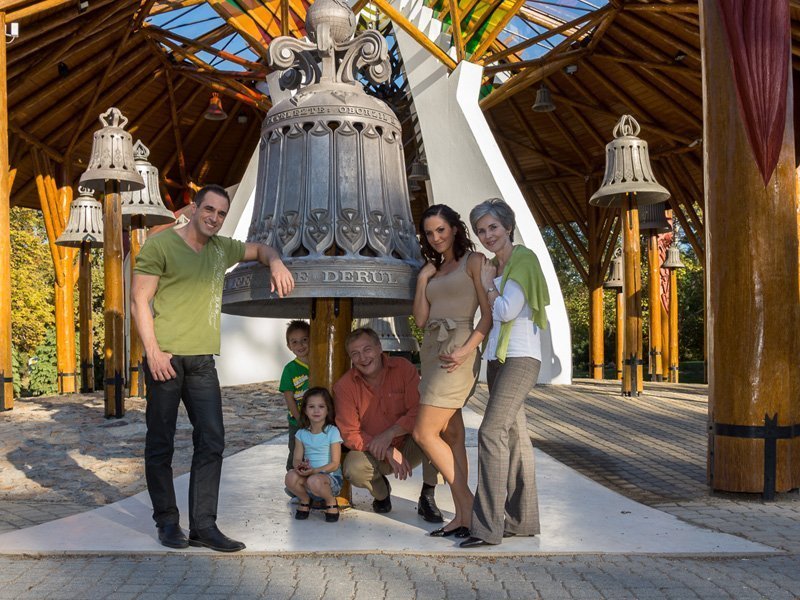
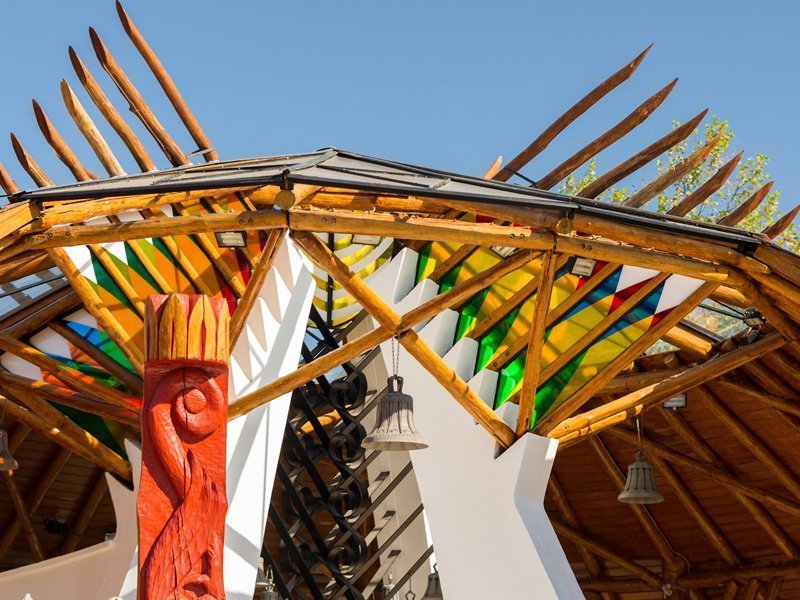
The Harangház is the youngest architectural work in Hajdúszoboszló, and it is a building for housing and displaying the Oborzil bell legacy donated to the city.
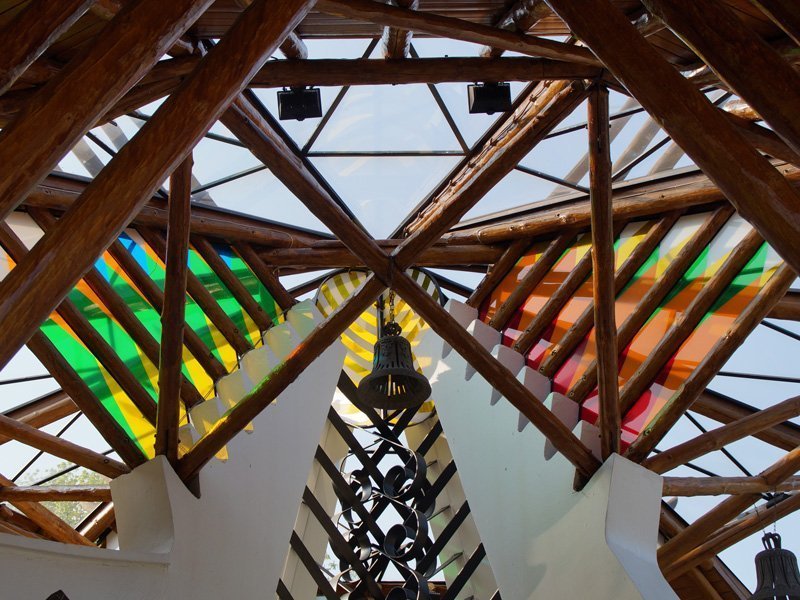
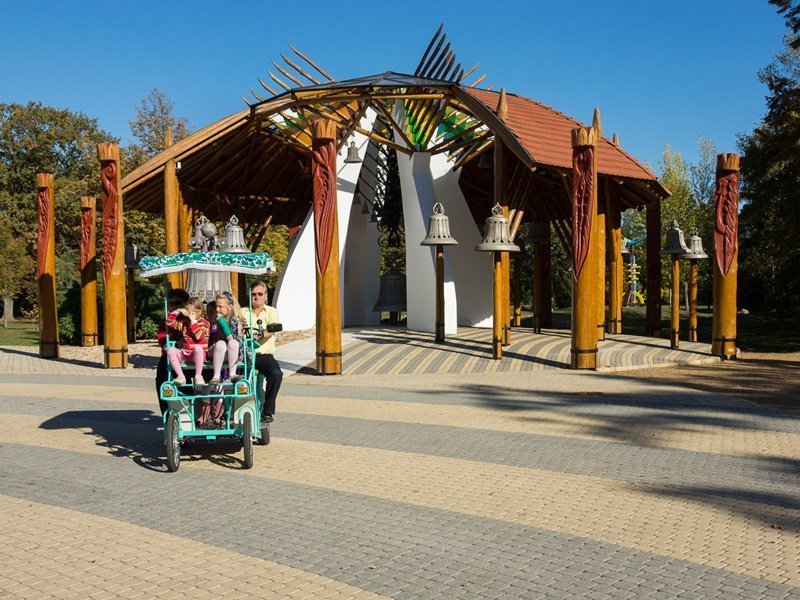
The circular open building has a preserving and presentational role, housing 50 aluminium bells bequeathed to Hajdúszoboszló. When designing the building, the architect Zoltán Rácz used several symbolic systems, as the four pillars of the bell house mark the four seasons, the four cardinal points and the starting points of the bell system.
The building of the Bell House is located in the park between the Spa and the main street of the town, the architect's idea is that it represents the symbolic Carpathian basin, into which four springs flow from the three painted trees in the adjacent park.
The spirit of the three painted sign trees fully supports and enhances the functional and symbolic role and value of the building. They represent the legend of Turul, the story of the Wonder Stag and the myths and legends associated with the Tree of Life, and emphasise them through their colouring.
The three symbol trees are called Turulo, Wonder Deer and Soul Bird. The symbol trees represent the following missions in the world:
Turulo the fulfillment of the mission of the House of Árpád, the Hungarians
the mission on earth of the Wonder Deer, based on the knowledge of our ancestors in recognising celestial values
the Tree of the God of the Soul, the Tree of Life, symbol of the ability to be reborn.
On the markers you can read the following inscriptions in ancient runic script:
Turulo: Blessed beautiful sun, bright beautiful sun, born at dawn, appears, shines
Wonder Deer: I am an ambassador from the heavenly Father, I am sent by a great law
Soul Bird: The Earth is ripe for a new birth
The bells of the Bell House are unique creations, inspired by the stone carving, engraving, jewel inlay, cloak patterns, embroidery and braiding of the XI-XII centuries. The symbols on the bells are closely linked to the founding of the state, while the ones around the small lake are specially made to commemorate St Stephen, and each bears a sentence from the laws of our founder in Latin. From here, the historical tableau, like a Feszty ornament, winds its way around the carvings on the wooden pillars around the perimeter of the building, from the time of St Stephen to the present day. The basin, the first column after the foundation of the state, depicts the constant warfare of the 11th and 14th centuries. The carvings on the other columns depict the following:
Column 2: the power struggles in Central Europe, the conquest of the Turkish army, the victory of the Battle of Nándorfehérvár
Column 3: the rise of the Reformation and Calvinism, with the lamb and the pelican as symbols, sacrificing himself to his chicks
to feed
Column 4: Hungary divided into three parts
Pillar 5: represents the reign of the Habsburg dynasty, which lasted for four hundred years
Column 6: the Rákóczi War of Independence
Column 7: the 1848-49 War of Independence, which is also the chronological position of the Kölcsey Bell, which stands between columns 6 and 7
Column 8: the establishment of the Austro-Hungarian Monarchy, the dualism era
Column 9: Trianon, the break-up of historic Hungary
Column 10: 1956, 1989 „We are free”
Column 11: What next?
If you're staying in Hajdúszoboszló, take a walk to St Stephen's Park and admire the unique building of the Bell House with its carved columns and the painted signposts in the park behind it.