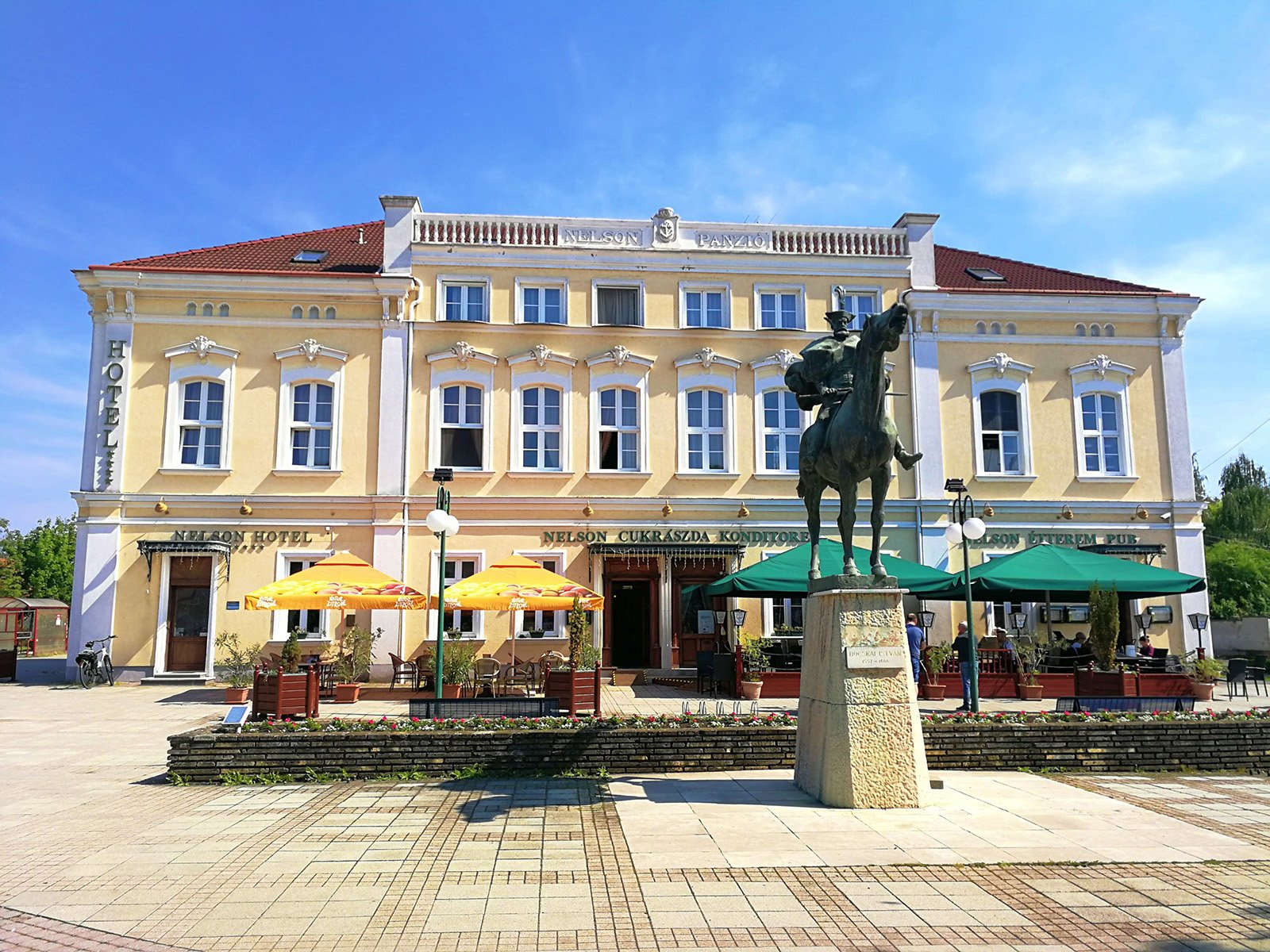
The small town in the lowlands was radically transformed by the development of rail transport, which began in the 1850s. Increased passenger and commercial traffic prompted the town's leaders to build modern, long-service inns. Thus began the construction of the BIKA inn, which opened in 1860.
By the 1870s, the town was in dire need of a guesthouse where it could accommodate its official guests or delegates and officials who came to the town on business. The BIKA inn was not only a place where the city's official guests were catered for, but also a major venue for social and public life.
The restaurant was built in 1871, and is still visible in the main square of Hajdúszoboszló. The one-storey building is located on the corner of Kossuth Street, on a city plot. Its frontage facing the highway was built in such a way as to be in line with the row of buildings starting from the town hall and extending to Kossuth Street. With the empty space in front of the building, the market square was approximately doubled in size.
The entrance to the restaurant opened from the square in the middle of the building, with stairs leading upstairs. The guest rooms and a large spacious restaurant were located here. The ground floor also had shops facing the square. The building, known as the Little Babe, was not only a hotel and restaurant, but also a centre of cultural life in the city. The large upstairs restaurant was used for theatre, art performances and political meetings.
In the 1930s, the catering scene moved to the area around the spa. From 1950, the tax office was replaced by the Defence Forces Supplementary Headquarters. The whole building was then used by the catering company. The name was also changed. The building was formerly the Délibáb presszó, the Bástya confectionery, and is now the Nelson Hotel, Restaurant and Confectionery.
The main façade of the building facing the square is divided into two parts by the ground floor and first floor windows. The lower floor has rectangular windows, while the upper floor has arched and sills. The upper floor windows are also separated from each other by four straight mullions with a 2+6+2 division.
The „Kisbull Guesthouse” has been standing guard in the main square of Hajdúszoboszló for more than 140 years.