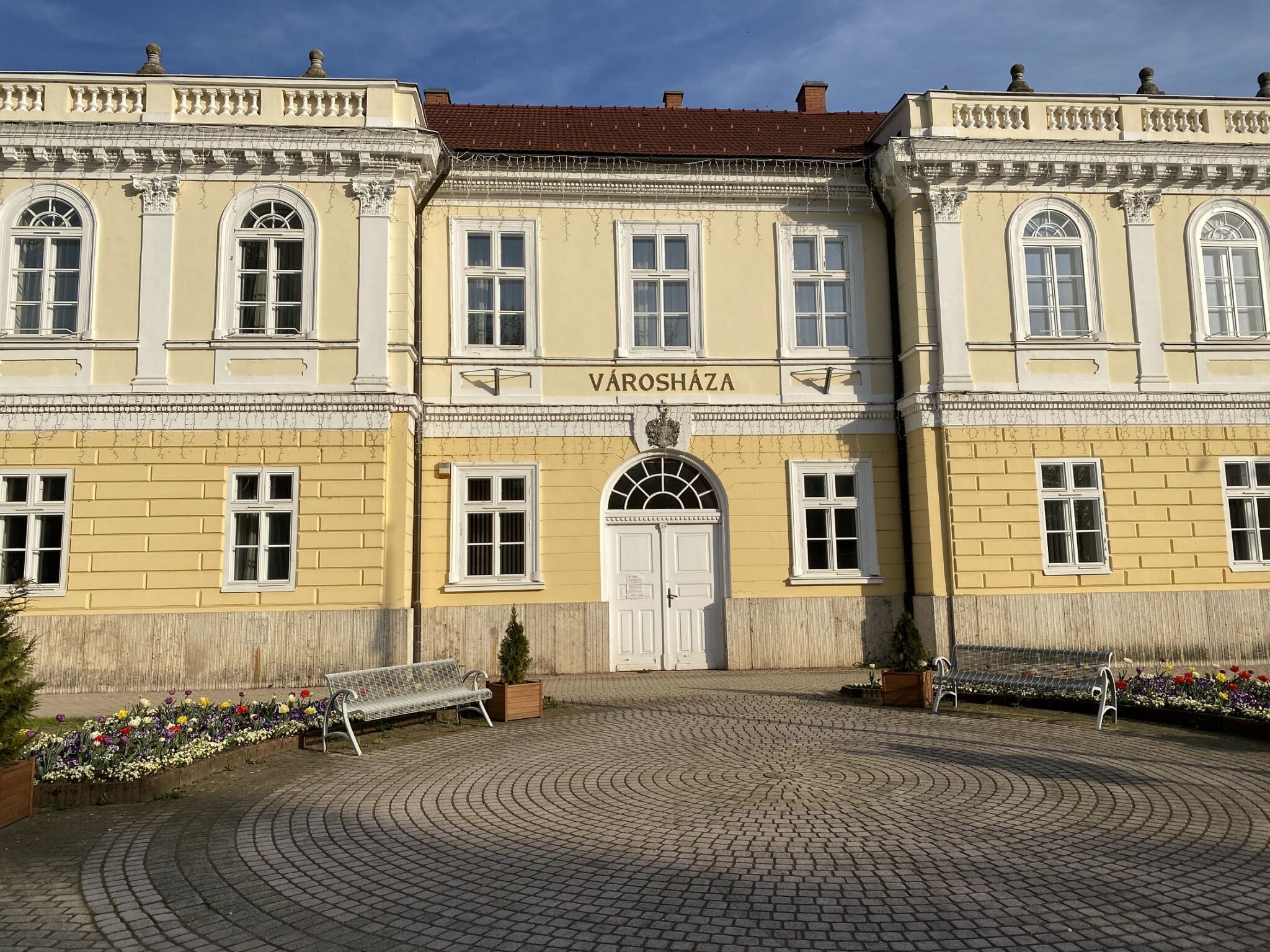
The old thatched-roof town hall, which was no longer fit for purpose, had to be replaced by a new one. A deal was made with the master Rabl Cornelius from Debrecen, who built the Reformed church. The master drew up the plans and on 20 May 1818 „the foundations were laid for the town hall to be built opposite the church.”
The entrance to the one-storey building, built on the site of the „Inner Taproom”, was from the courtyard. In front of the rooms on both floors was a corridor with a shop door. From the ground floor, six columns rising between the shopfronts supported the upstairs corridor and the courtyard section of the roof. The corridors opened onto the entrances to the offices. Under the stairs leading to the upper floor, the prison was replaced. The street façade facing the church was made tripartite by moving the central part, which housed the large council chamber, one metre away from the other two walls.
Construction took three years. The final stage of the work was the glazing of the windows and the completion of the mud ovens. This was because the offices were heated with straw and pipes. „Iron furnaces were only installed in the rooms later.
The current form of the town hall was created in 1896, the year of the millennium of the conquest. At that time, the fourth section towards Rákóczi út was added. It was added in the same way as the central part of the earlier building. This gave the town hall its present façade.
In 1935, a remarkable transformation took place in the part of the town hall facing the church. A main entrance was opened here, sacrificing the former Strasser's room. The renovation and the cost of the decorative gate was borne by a wealthy and distinguished local resident, Daniel Stahler.
The whole building was completely renovated in the 1970s and again in 1998. The latter also resulted in a more varied façade colour scheme. Today, the building is horizontally structured, with a calming effect and neoclassical elements. Between the 4 to 4 semicircular windows on the upper floor, there are the same number of Corinthian half-columns. Above them, the roof is flanked by a low, open-worked stone balustrade divided into six sections.
The 180-year-old town hall is a particularly beautiful sight in the evening floodlight.